 aPhantom.net
 European Adventure - Part Two - Life at Sea
What do you do for ten days aboard a luxury ocean liner? I suspect if you tend toward hard core type-A behavior, you might be disappointed, but we found it amazing how time flies when you are having fun. Where the typical cruise seems to be a way to travel between places to shop, the transatlantic cruise is more about the trip itself. For many people that we met, this was not their first trip on one of the Cunard Line ships. There also seemed to be many more seasoned travelers who were used to long trips to faraway places and had many tales of trips to exotic destinations. As one might suspect on a ship that does regular crossings of the Atlantic between New York and England, the mix of passengers was a little different than the typical trip that caters mostly to Americans. The majority of passengers were from UK, followed by Germany, and then USA, with a mix of just about everywhere else imaginable. We enjoyed the international flavor and the chance to meet travelers from around the world.
We both agreed that things were somehow more “civilized” on the QM2 than we had been used to on other cruise ships. A good example was the lifeboat drill. This is a required procedure for all passenger ships but apparently can be conducted according to the specific cruise line’s rules. On previous cruises, we were required to go to our stateroom, put on our lifejackets, go to the location of our assigned lifeboat, stand in line with women and children in front, and be checked off the list before the ship could leave the dock (or so they said).
On the Queen Mary, you did need to retrieve your lifejacket from your stateroom but you could simply rest easily in the dining room while one of the crew demonstrated the proper procedure for putting on the lifejacket. We listened to the demonstration in several languages and then got back to the “leaving the dock” party on deck. Much more civilized, indeed.
The ship was very well appointed, with beautiful art and many historical items on display in the halls and public areas. Cunard is very proud of its one hundred and seventy-five year history of transatlantic service and many historical events are portrayed on the ship. Just passing through the halls is a pictorial history lesson. Along with the standard theater for the Vegas type shows, there was actually a planetarium with regular shows every day, a beautiful spa and fitness center, a room for fitness classes, a casino, shopping areas, three formal dining rooms, an entire deck for the daily buffet and dining area, and the most impressive library we have ever seen on a ship with dozens of aisles of books on lighted glass-enclosed shelves. The art even extended to the outside of the ship where shiny new spare propellers are firmly fastened to the teak decks where we hoped they would remain as art objects and not necessary parts.
Each day had its lecture series, we especially enjoyed one about the history of flight. There were also movies and concerts, entertainers, comedians, instructors, the bridge club, the bingo games, gambling lessons, dancing lessons, fitness classes, spa demonstrations, ship tours, and kitchen demonstrations for ice carving and how they do those fancy fruit designs. There were plenty of activities to keep two thousand passengers busy every day. We participated in some of the activities, but also enjoyed our balcony and watching the sea passing by with someone else doing the steering, navigating, cooking, and minding the ship. We could get used to this.
At noon each day, we would get the “noon position” announcement from the captain and the navigator. This would also include the number of kilometers traveled and the number remaining to our first stop in Southampton, England, also a weather report and wind and weather forecast. Contrary to the tales of stormy weather and monstrous seas in the North Atlantic, our voyage was very pleasant. The highest seas we saw were about three feet and the highest wind speed was about ten to fifteen knots, but mostly it was sunny and calm. We had a couple days of clouds and rain and one day of quite dense fog. On most days, all of the ship’s clocks were set ahead one hour at noon to compensate for the time change as we moved closer to Greenwich, the ship version of jet lag.
The captain usually also included a story or an anecdote about ocean traveling when addressing the passengers. On one occasion we learned that our course on this trip would take us about two hundred miles further north than the course of the Titanic, but we should not worry as we were making our passage in the middle of summer, not the middle of winter.
On another day the captain informed us that we were crossing the Atlantic Ridge where the tectonic plates of North America and Europe are moving apart at approximately four centimeters per year. In the one hundred and seventy-five years that Cunard ships have been making this passage, the distance between the continents has increased by about seven meters, which he said accounted for the extra two days required to reach Southampton. This, of course had nothing to do with the price of fuel or any other economic considerations. Quite a comedian, our captain.
We saw virtually no other ship traffic until we got near Southampton, but there were sea gulls nearly the whole way and the occasional dolphins if you happened to see them. We heard tales of whale sightings but did not see any ourselves. The view of the sea is quite different from eleven stories up than it is from five feet above sea level.

At about six in the morning on the seventh day, we picked up our pilot and made our way into the winding channel of the Solent to the port of Southampton. Whoever was steering the ship made a complete one hundred and eighty degree turn in the narrow channel and neatly backed the QM2 into a small berth that looked like it would only handle a small freighter. We thought that was quite a bit of fancy seamanship.
The port of Southampton is quite a busy place. Its proximity to London makes it a very busy freight terminal but it also handles quite a lot of cruise ship business. The literature says that it handles over one million passengers and over three hundred cruise ships per year. It’s not hard to imagine that means quite a bit of money to the local economy. The view from our balcony showed four multi-level parking lots for shipment of automobiles, trucks, and tractors. We watched a steady stream of mini-coopers filling up one of the car carriers currently in port and several other ships loading and unloading containers.
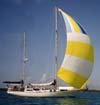
The other thing that Southampton is famous for is its yachting community. The Isle of Wight, which protects the harbor of Southampton is home of the famous Cowes Week Racing Event and is also the start and finish of the famous Fastnet Offshore Racing Event. This is one of the largest regattas in the world and was happening at the same time the Queen Mary was in Southampton. The Solent, which is the body of water between southern England and the Isle of Wight is the sight for most of the sailboat races that take place for this event. It is also the main channel for all ship traffic to Southampton which must make the racing pretty interesting. We were really too far away and had too little time to see any of the events, but we did see a couple of the big racing boats, one in the boatyard nearby and one returning from racing or practice.
After discharging the passengers who were leaving the ship at Southampton and loading new passengers and supplies for Hamburg and future destinations, we were on our way back out the winding channel at about seven p.m. We rounded the Isle of Wight and sailed into the English Channel just as it was getting dark. This body of water was living up to its name as the world’s busiest shipping channel as there was not a time in the next several hours that we could look out our balcony and not see the lights of some sort of shipping traffic nearby. We were glad we did not have to do the navigating in our small boat for this part of the trip.

Hamburg is about seventy-five miles up the Elbe River from the English Channel. We picked up our pilot and made our way up the river mostly in the middle of the night. It seems that the Queen Mary needs high tide to clear the highway tunnel that runs under the river near Hamburg. We arrived at about two a.m. and once again the ship made a perfect one hundred and eighty degree turn in the narrow river. It was hard to believe that our luxurious cruise was over. At about nine a.m. we picked up our bags and prepared for the next phase of our European Adventure.
Click Here for the picture Gallery. The small rectangle on the bottom right views full screen.
Click Here for Part One. Click Here for Part Three.