 aPhantom.net
 Bahamas 2010 - Part Four
Marsh Harbour to West Palm Beach
Click any photo to view Photo Gallery
We spent almost two weeks in Marsh Harbour, getting to know the town. At the east end of the harbor was "restaurant row" with Curley Tails, Mangoes, and Snappas huddled together and the more elegant (air conditioned) Wally's across the street.  The Jib Room on the opposite side of the harbor ("Come to the Other Side") featured steak night on Saturday and rib night on Wednesday. The entertainment was provided by a local "rake and scrape" band. The primary instrument is a regular hand saw "played" by drawing a metal rod across the teeth and sides of the saw. There were also drums and the familiar island beat as accompaniment. Later, after enough adult beverages had been served to limber up the guests, the limbo bar appeared and spinal columns were challenged.
There are four small marinas in Marsh Harbour, two of them have just a single dock. The Conch Inn Marina, the largest of the four, is the home of Moorings and Sunsail Charters. Most of the charter boats are catamarans, some with as much room as a small apartment and shallow draft, a great combination for the area. 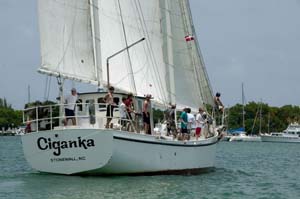 The marina was also the turnaround point for charters by the Boy Scouts of America. Every week about a dozen scouts, with their scout leaders, all their gear and matching t-shirts, would be loaded onto one of several fifty or sixty foot sailboats and head off on a sailing adventure. It must have been quite a treat for some scout troop from Iowa to experience real ocean sailing in the pristine waters that surround this area. They were all smiling and sunburned when they returned.
The harbor itself stays busy with small freighters coming and going most every day. There is a small container offloading facility that keeps the local businesses surprisingly well supplied. There is a huge hardware store that could rival almost any Home Depot and the promise of a very large and modern grocery store that looked finished right up to the landscaping for the parking lot. The sign said "opening fall 2009" but July of 2010 found it not quite ready yet, working on "island time". Most items for sale seem to be about twice the price of what we might expect in the states. Most everything must arrive by ship or air freight and we were told that there is a sizable duty on many items.
The town itself is very "cruiser friendly" with many places to land and tie up a dinghy and almost everything within walking distance of the harbor. We had settled into a relaxed routine that included the camaraderie of varied boaters, some just starting out and others who make the same trip each year. Most were Americans, but there were French, German, English and even some cruisers from Australia. We think that one of the main things that makes this lifestyle so interesting is the people you meet along the way. They all seem to have an interesting story to tell.
Most days started with the "cruiser's net" each morning at 8:15. The "net" is run by local cruisers and ex-cruisers and provides valuable weather information. The Bahamas has no twenty-four hour VHF weather broadcasts or local weather channels, so any weather information is greatly appreciated. Most summer days the forecast is the same, east wind eight to ten knots, chance of afternoon and evening thunderstorms, temperature eight-five to ninety degrees. It is the tropical storm information that we were really interested in and we didn't have long to wait until a storm was brewing to the south of us, heading in a northwesterly direction.
What was now tropical storm Bonnie was predicted to pass just to the south of us and then move on to south Florida. As soon as that information hit the net on Thursday morning, the anchorage became a beehive of activity. The storm was predicted to remain a minimal tropical event but there was an abundance of warm tropical air and water between us and the storm and who knows how accurate these predictions really are? Almost everyone put out an extra anchor and tied down or took in any loose items on deck. Like most nasty storms, this one arrived in the middle of the night. There was a surprisingly small amount of rain but winds were a steady thirty knots with some gusts to forty. All the anchors held firm and I don't believe that anyone had any damage. The storm moved on and the adrenalin of anticipation finally returned to normal levels.
 With weather conditions predicted to improve over the next several days, we were making our plans to move on. However, we had one more item of business to conclude. A French couple on a French catamaran with an unpronounceable (to us) French name had made an offer to buy our Trinka sailing dinghy. We really loved this little boat but when we were honest we admitted that we really never use it and it's always in the way for anchoring. At every anchorage, we have unloaded and re-loaded and secured it onto the deck. After nearly two months on this cruise, we have yet to row or sail it anywhere. We traded it for some dollars and euros but were sorry to see it go. Our foredeck seemed a little empty.
We picked up our extra storm anchor and our regular anchor and headed out toward Green Turtle Cay, about twenty miles to the north and west of Marsh Harbour. This was actually a great day for a sail and we were finally going in the right direction to take advantage of it. The route to Green Turtle includes a passage on the outside of the barrier island at Whale Cay. Just inside the cut, there are some remnants of a "private island" that was used by one of the large cruise lines. It is said that they abandoned the site because there were too many days that the passage was impassable even for a large cruise ship. We think this story might be a little thin, but then we haven't tried to make this journey during a winter storm. The passage was delightful on the day we came through, with just a bit of an ocean swell and just the right amount of wind to push us through. We anchored just outside of the harbor at New Plymouth, Green Turtle Cay and made our way to shore for a rum at Pineapples Restaurant and Bar.
 The next day we toured the historical town of New Plymouth. It has the feeling of an eighteenth century colonial town and appears as though some of the buildings have actually survived since then. We found it pretty much unchanged from when we visited eight years ago. Unfortunately, we arrived on Sunday which meant that many of the businesses were closed. Also closed was a charming museum that we had previously visited.
There are actually two "inside" anchorages at Green Turtle Cay. Black Sound is just to the east of New Plymouth and White Sound is just a short distance to the north. Both have pretty shallow entrances so we decided to tour by dinghy. It was nearly low tide when arrived at the entrance to Black Sound and we saw birds walking behind the channel markers. This was another pretty well protected harbor with a marina and many moorings. There was also a full-service boatyard that specializes in hauling and storing boats on land in their very large boatyard. This, of course, is also a hurricane solution. There were perhaps about one hundred boats stored in this manner, a veritable forest of sailboat masts.
White Sound carries a bit more water and has a long, well-marked entry channel. The two main marinas are Green Turtle Club and Bluff House Yacht Club. These are both actually resorts with hotel rooms, villas, swimming pools, nice restaurants and bars. 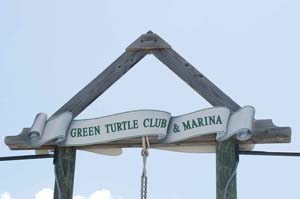 Both clubs have been around for many years and seemed to be doing a pretty brisk business. The bar at the Green Turtle Club is one of those places where many visitors have scrawled a message on a dollar bill and attached it to the wall, ceiling, furniture or decorations. The bar was also air-conditioned, how very civilized!
The next day we decided to keep going while we still had some wind in the right direction. The wind was lighter than the day before and seemed perfect weather to fly the GLAS (Gigantic Light Air Sail). This is a colorful and mystical piece of equipment with mysterious ropes and pulleys (lines and blocks). It lives in a "sock" that is used to retrieve it. Theoretically, you pull the sock down over the sail, it collapses and gracefully floats to the deck. In practice, we usually end up with at least part of it in the water and the lines in a tangle. We'd had a new and improved sock put on the sail but our technique still needed some work. We looked good while we're flying it though.
Our destination was Spanish Cay. If you have been following along, you will remember that this is where we checked in for customs and immigration when we arrived in the Bahamas. Sophie, the Bahamas Customs Agent, was still in the bar, checking in the new arrivals. So this was completing a circle for us, as we were now heading back to Florida. There were several large sportfishing yachts just back from a successful day of fishing. Their fish cleaning activities attracted an impressive group of large sharks who were quick to snap up any small bits that hit the water. We decided that this was a great way to deter swimming in the marina.
Spanish Cay is a totally self-sufficient island that provides its own power, water, and all amenities. Approximately every three weeks, the big diesel fuel barge from Nassau pulls up to the fuel station and offloads enough fuel to keep the island running. There are huge generators, a three hundred gallon per hour desalinization plant, and a private ferry that runs twice every day to Cooperstown to bring supplies and workers to the island. It's quite an impressive operation.
Dan and Sue, who manage the marina, the restaurant, the rental properties, and everything else on the island were busy preparing for the beginning of Lobster Season which was only a few days away.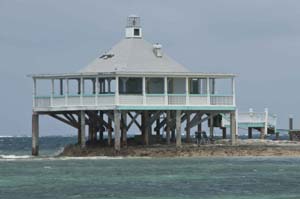 This is a busy time for the resort and all of the villas and slips in the marina were reserved for the following weeks. As a special project Dan had taken on the restoration of "Wrecker's Bar" on the ocean side of the resort which had been closed for several years and fallen into disrepair. In his best Tom Sawyer fashion, Jim volunteered to help with the bar and some other land-based projects so we ended up staying a couple of extra days at the marina in air-conditioned comfort with the pool and restaurant nearby. By Thursday, the people with reservations were beginning to show up. We said our good-byes and and set out for the anchorage at Great Sale Cay, forty miles to the west.
This should have been an easy downwind sail. It wasn't. The prevailing easterlies turned west so we ended up motoring into the wind all day. We decided to anchor on the east side of the narrow spit of land that is Great Sale Cay to get some protection from the rolling waves from the west. Soon after we arrived, the wind turned south and sent the rollers right into our anchorage making sleeping in the forward berth seem like a night on an amusement park ride. We began to question our timing. Was there some cosmic force of Murphy's Law following us around?
Our plan the next day was to make the next forty miles to Grand Bahama and spend a couple of days at the marina stowing the dinghy and motor and getting prepared to make the fifty mile trip across the Straits of Florida and the Gulf Stream toward West Palm Beach. The wind remained stubbornly from the southwest and became just a zephyr by the end of the day. When we got close enough to call the marina on the VHF radio, we found that "lobstermainia" had struck them as well and there were no slips available. This was quite a shock after all of the mostly empty marinas we had seen along the way and proof that Murphy might still be lurking about. We discussed our options and finally decided to just keep going. It wasn't going to be the pleasant sail we had hoped for but the sea was mostly calm and if we kept on at our leisurely pace, we should arrive at the Lake Worth sea buoy just about the time the sun would be coming up.
There was one last strange event as if we weren't uneasy enough already. Not long after we had made our way off of the Bahamas Bank and into deep water, we saw a black object floating just to the south of us. After some scrutiny with the binoculars, we decided it was an upside down boat hull. With some trepidation, we moved in closer to investigate. It was about a thirty foot open fishing boat with its black bottom just out of the water. No one was around and it looked like it might have been floating for some time. We called the marina on Grand Bahama and asked them to report it to the Bahamas Rescue Service. 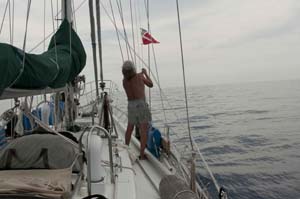 It was nearly dark by this time and we resumed our course to the west. We took down the Bahamas courtesy flag and were officially in open water.
The night was clear and the sky was full of stars. We seemed to leave Murphy and his cosmic weirdness behind, crossing the Gulf Stream without any further incidents. We arrived at the Lake Worth Outer Sea Buoy at about seven am, just as it was light enough to see the entrance. A short trip inside the harbor and we were anchored for some much needed rest. The shock of our arrival back to "civilization" was complete when we discovered that within twenty-four hours, we were both required to make an appearance at the customs office which was a forty dollar cab ride away. The difference between this experience and Sophie's friendly welcome in the bar were quite dramatic. Another trip to the Bahamas was sounding pretty nice indeed.