 aPhantom.net
 East Coast 2012
Click on any Photo to view Photo Gallery. It's best viewed in full screen mode.
The day after the storm.
The wind howled and the rain poured down and then it was a nice day. Tropical Storm Debby had her way with us for several days. This was an unusual storm in that the really bad weather was no where near the eye of the storm but far to the east and north.
 We had just launched the boat in St. Augustine after her biennial trip to the boatyard for bottom paint and the inevitable list of other stuff to be done. The painting was finished on Friday and we were scheduled to launch at high tide on Monday. The slip where the boats are hauled out is not deep enough for our six foot draft except when the extra four feet of water has flowed into Oyster Creek with the tide. The current fairly rips through the creek at mid tide when the water is flowing at its fastest. The launch slip is perpendicular to the creek so that makes the operation even more interesting at any time other than high or low tide when the speed of the current is at its lowest.
We managed to launch and get to a slip along the creek without incident. I left Jim to scrub off the grunge, slime, and sludge from the boatyard and began provisioning for the trip. As we had decided just the week before that we would not be going south to the islands this summer, provisioning needs had changed somewhat. If you are going to the Bahamas, you really need to bring everything you think you will need for as long as you think you will stay. There are some food and liquor stores along the way but most everything is at least twice as much as we would pay for it here and generally the selection is, shall we say, limited. A trip up the east coast of the U.S. on the other hand means there are always stores, maybe not nearby but accessible. We'll never be far from a Wal-Mart or a Publix but we won't have a car so it's easier to be prepared. We might find an anchorage where we'd like to stay long enough to use up our supply of beer and wine.
I managed to dart between the raindrops of the tropical storm, down a long dock and get everything loaded in my "pantry" ( a locker of three shelves about 3 feet by 3 feet). This holds all of the dry stores and canned goods. Any other space not already occupied is fair game for storage. The beer goes under the berth (bed), and the wine goes behind the seats in the salon (the living room). The chips and crackers go in bags at the end of the bed.  As soon as I loaded the freezer, essentially an irregular box of about two cubic feet, it decided to quit working. It usually maintains a temperature of about nine degrees, but now it was twenty-three degrees and rising. We found someone to top up the refrigerant gas but the temperature was still rising. By Friday afternoon the freezer temperature had risen to thirty degrees. We bought a bag of ice, which just barely fit in with all the food. We managed to find a technician who agreed to an emergency service call on Saturday morning. He tested and probed and performed some magic and suddenly the temperature began to move downward. There was an audible sigh of relief from those of us who had visions of cleaning up a soggy mess of expensive, used-to-be frozen food. Another day of rain and wind and nasty weather and then, suddenly, it was sunny and bright. The actual eye of the storm passed pretty close to us but by then there was only an occasional thunderstorm and some strong North wind.
We decided to give the sea another day to calm down and went north on the Intracoastal Waterway for about ten miles where we spent the night at anchor in a creek in the marsh. There were no Wal-Marts there, just a few shore birds and a visiting pod of dolphins. We watched a lovely sunset and seemed to be whispering to each other because it was so quiet.
The price that you pay for a night in the marsh is the bugs. They love to buzz and flit and bite and generally irritate all humans. We had expected as much and so were (somewhat) prepared. We had visited a gun shop (no, we were not going to shoot the bugs), and interviewed the salesman about what the deer hunters use to combat the bugs while sitting in the swamp for hours waiting for Bambi to happen by. He recommended an apparatus that contains butane gas and some magic potion that he "guaranteed" would discourage all types of flying biters. To say we were skeptical would not be an exaggeration, but this seemed like the perfect time to give the magic instrument a whirl. You insert a small butane cartridge and a small pad of "bug juice" and it glows happily and sends out a small puff of mist. Viola! Bugs be gone! They scurried quickly away from our sleeping compartment. One charge is supposed to last for four hours but we made it through the night pretty much bug free and were not dead from whatever was emanating from the device. I think we can safely say that is a positive recommendation. Thank you deer hunters.
We were up with the sun the next day and on our way to the next ocean inlet. Jacksonville is a big ship entrance and thus is wide and deep and easy to navigate. We were basically ejected out of the inlet as we somehow managed to arrive with the outgoing tide. We flew out of the river at nine knots, not notable for most power boats, but pretty exciting for a lowly sailboat.
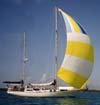
We had been watching the weather forecast for days and this time it was right on the money. We had sunny weather and wind from the southwest at ten to fifteen knots just as predicted. We had been discussing our destination and had not quite decided but no matter where we were going it was to be in a north and east direction so wind from the southwest would work just fine. We quickly raised the sails and were clipping along at a steady seven knots in pretty much the correct direction. This was basically unheard of in our sailing history.
As the day wore on the wind became lighter and from a more southerly direction. This meant we needed to change direction or end up on some beach in Georgia in the middle of the night. Some sailing terms might be in order here. We were sailing on what is termed a "broad reach". This means the wind is coming almost from behind you. Usually when you want to change direction in a sailboat you "tack" which means bringing the pointy end of the boat through the direction of the wind, ending up with the sails on the other side. When sailing on a broad reach it is often easier to "jibe" which means to bring the stern through the wind instead. This is a little more tricky as you must first bring the mainsail slowly to the middle of the boat and then easily let it out on the other side. On any point of sail this far off the wind we also rig a "preventer" which is a block and tackle attached to the boom to "prevent " the mainsail from suddenly changing directions . All of this rigging must be loosened and tightened as part of this maneuver as well. The object is to keep control of the sail and not let the wind get on the other side until you are ready to change direction. You definitely don't want all that boat hardware slamming from one side to the other at a rapid rate. So we made our plan for "controlled slamming", executed a nearly perfect jibe, and were once again off in almost the correct direction.
This new direction was taking us farther out to sea. Once again our speed picked up but so did the size of the waves. By now it was dark but we had a three-quarter moon to keep us company. We each tried to get some sleep but the motion and all the creaking and rattling as we rolled from side to side made any real sleep impossible. At about three a.m. we were back to our GPS track northward and decided that we should jibe once again as we were far enough from land to avoid any shallow water. The moon had just set so it was really dark as we tried the controlled movement once again. Not so perfect this time as the boom came around with a crash. We shined a light around the deck and rigging. Everything looked fine but we vowed to work on our jibing technique as soon as it was light.
Many cruising sailboats are equipped with a device called wind-vane steering. This is an ingenious device that attaches to the steering system of the boat and adjusts the rudder to keep it at the same angle to the wind. There's a "paddle" on the top that is free to move as the wind flows across it. There's a "foot" in the water that slides off to the side if the wind moves the paddle. The foot is attached to the steering system and thus moves the steering wheel to keep the boat sailing at a constant angle to the wind. It makes a happy little groaning noise as it adjusts the wheel that sounds like it's talking to you. For this reason or maybe just because sailors are weird, most everyone has a name for the wind-vane. Ours is named Hector.
Hector had been steering since we left Jacksonville. In steady wind, he usually holds a compass course of about ten to fifteen degrees variance which is better than human steering because Hector doesn't take breaks or sightsee along the way. As the wind speed picked up during the night Hector was having a tougher time holding the course. The waves were now larger, slewing the stern around each time one passed under the boat. Hector was only able to hold our course variance to about thirty degrees. We had rolled in some of the headsail to try to ease the motion and decided we should probably reef the mainsail as well to ease the steering for Hector. It would be light enough to see in about an hour so we decided to press on with our current configuration and re-assess at daylight.
At about four-thirty in the morning, a large wave pushed our stern a little too far to starboard causing an accidental jibe. The sails were now both on the wrong side of the boat with the preventer holding the boom to starboard. It was now too dark to see anything but clearly something had to be done immediately. We released the preventer to allow the mainsail to come across to the port side and prepared to tack through the wind. Of course, since Murphy is alive and well, the sheet for the headsail got caught on something forward and could not be winched in. Jim had to scramble forward and get everything sorted out on the dark slippery deck while I hand steered a careful course to keep anything else from going in the wrong direction. Finally, the headsail was under control and we were back underway. We tacked again to come back to our course but when we went to set the mainsail it would not adjust properly. We turned on the deck light to investigate and discovered that one of the blocks holding the mainsail had basically come totally apart and was hanging pitifully from the bottom of the boom. Jim rigged some blocks and line to keep the boom from getting away should the other block (of the same age and brand) decide to do the same thing. 
We decided to hand steer for the next hour or so as we did not feel comfortable letting Hector take control again. The surge of adrenaline and lack of sleep had made us both zombie tired. At about six a.m. we decided to try turning on the autopilot which is the battery powered version of Hector. It works by steering a compass course and doesn't care what the wind is doing. This turned out to be a better choice for the conditions as it was able to keep a much closer course. By this time we were getting closer to land, the waves were not quite as large and the going got a little easier.
We started calculating distances and times to the next inlets. We had originally planned on Charleston, but our present course and speed would put us at the Charleston Light at about two a.m. We were not fond of the thought of going into any inlet at that time of the night so we re-calculated and figured we would get to Savannah in about three hours or about nine a.m. As we now had a list of items that needed to be repaired, Hilton Head Island became our new destination. It also required no more course adjustments so that pretty much clinched the decision.
We arrived at the channel entrance as predicted and once again the tide was rushing out. The wind lightened up and the tide kept pushing us out so it seemed we would never make the harbor. We finally started the engine and motored in the channel and up the river to Shelter Cove Marina in Hilton Head.
It was almost like homecoming as we had kept boats in this marina for many years in the past. Things have changed some but some of the same people were still there. We pulled in, tied up, drank some beer and wine, turned on the air conditioner, and took a long nap. We're not as young as the last time we were here so maybe we'll stay for several days of rest and ponder the next voyage.
Click Here to view Photo Gallery. It's best viewed in full screen mode. Click on the right most symbol, then click on the right arrow to start the slide show.
Click Here for Part Two of this trip.