 aPhantom.net
 The Carrera del Golfo al Pacifico
Part One - Getting There
Click any photo to View Photo Gallery
 The translation is “Race from the Gulf to the Pacific” and it consists of about 650 miles of twists and turns on central Mexico’s highways and back roads with days of parties before and after. Someone who drove with us said it has been described as a moving party with a road rally in between. The race in February,2010 was actually the ninth running of this version of the rally and was one of the first official events of the year marking the bicentennial of Mexican independence. This event has a long history as rallies of this type have been run in Mexico since the early 1950s. Mexico takes its car racing serious so for the bicentennial year there were about thirty official races and rallies scheduled. As racing is only a small part of the scheduled festivities, it’s sort of like Cinco de Mayo for an entire year.
The whole event started for us in the spring of 2009 when we attended the Jaguar Clubs of North America (JCNA) Challenge Championship in San Antonio Texas. That was where we met Brian Blackwell and Victor D’Souza, both veterans of the Carrera and enthusiastic promoters. Their tales of camaraderie and the graciousness of the Mexican hosts piqued our interest. The idea of touring Mexico with a group of Texans who knew the best routes and had the best connections made the idea even more compelling. It was mid December when we actually made the commitment to go and there was much to do before the early February departure date.
The first order of business was completing all of the paperwork. This included the registration and application for a Mexican sport driving license, Mexican insurance for the car, copies of American driver’s licenses, passports, titles, registrations, and insurance forms. Each car is also required to have a current first aid kit, fire extinguisher, and road flares. Our travel group also required that we carry two-way radios, some spare parts and tools, and a full sized spare tire to replace the space saver spare fitted in our Jaguar XK8. Many sections of the rally require both driver and navigator to wear approved helmets. Brian provided us with a very helpful list of items to bring. When we looked at the list and the size of the XK8 coupe, we knew some compromises were in order. After much packing and re-packing, we found a place for everything including driver and passenger and were on our way to San Antonio to meet our fellow international road racers.
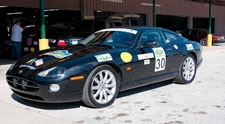
 We arrived in San Antonio three days later. Victor’s Service Center provided us with the perfect place for everyone to meet, perform last minute check-ups of cars, equipment, and drivers and apply all of the required race and advertising decals to the cars. The whole place took on a party atmosphere. How many Jaguar repair shops do you know of that include a bar as a permanent fixture? Pizza was ordered for lunch and the decal competition began in earnest with each arriving car vying for the most or most outrageous race decals. It seems this competition has gone on for several years and has now become so great that a professional artist was hired to provide and apply the selected signs and emblems.
We were truly amazed at the kindness and graciousness of the Mexican organizers of the event. One of our Mexican hosts personally delivered our racing packets which included official race decals, rally numbers and a very impressive letter to the Mexican Secretary of Public Safety requesting all Mexican Federal officials, including the police, to help with our transit to, from, and during the rally. Another of the main organizers of the event sent his son and two friends to drive with us from San Antonio to Veracruz to be of assistance should we need any help at the border or on the roads in Mexico. We hadn’t even left San Antonio and we were already feeling the warmth of Mexican hospitality.
We were instructed to arrive at Victor’s on Sunday morning and be ready to be on the road no later than 8am. Our group consisted of nine cars, three from Houston, five from San Antonio and ours from Atlanta. Spectators and well-wishers, including the former mayor of San Antonio, arrived for a farewell party, including breakfast burritos to get us in the spirit of things. A local pastor provided blessing of the cars and drivers and sent us on our way. Two uniformed motorcycle police provided an escort for us all the way out of San Antonio. We were definitely on our way in style and exactly on time.
 We arrived at the Mexican border at about 10:30am. All of the paperwork and clearing customs was completed by noon, record time for nine cars to pass through according to Brian. Our small caravan was becoming comfortable with Brian’s XJS in the lead and Victor’s V-12 E-Type bringing up the rear. The rest of the group consisted of a Jaguar S-Type, an Aston Martin DB7, a Mini Cooper ‘S’, a Dodge Charger, a Toyota Infinity, and a Corvette. The Mexican highways on our route were mostly four-lane, some with limited access. There were some pretty impressive pot holes but nothing worse than I have seen recently in downtown Atlanta. Armed with our letter to the Secretary and our personal escort, our average speed increased to about 150 kilometers per hour (95 mph) with speeds sometimes reaching 195 kilometers per hour (120mph), certainly faster than we are accustomed to driving on our US roads. We found Mexican drivers to be generally more courteous than American drivers, quickly moving to the right to allow faster traffic to pass. Absent were the inconsiderate drivers, ambling along in the left lane, in their SUVs, cell phones in their ears. We did, however, see horses, cows, burros and goats grazing in the medians and along the highways. One farmer, with a herd of goats, appeared to be waiting for a chance to shepherd his entire flock across the busy highway. Everywhere we went, people waved and shouted. The American racers were on their way!
All gas stations in Mexico are full serve with polite attendants to pump the gas, wash windows and provide services that we had forgotten existed. The gas prices are set by the government so pricing is the same throughout the country. The restrooms often have an attendant who rations the toilet paper and keeps the restroom clean. Both gas and restroom attendants work for tips and are eager to please.
Our destination for the first night was San Luis Potosi, about 600 miles from San Antonio. This was the first real town we had seen all day and it turned out to be a large city. Our route took us through the surrounding mountains with all the city lights below, a quite impressive sight. We arrived at our hotel at about 8pm, just in time to see the last minutes of the American Superbowl, a delight for the New Orleans Saints fans among us. Another party, dinner, drinks and camaraderie completed the evening.
The next day started with breakfast at 7am, and all cars were on the road just before 9am. Our route took us around Mexico City with its legendary smoggy air and a huge valley of oil and gas refineries. The road through the mountain pass topped out at about 8900 feet elevation, surrounded by snow capped peaks, which seemed a strange sight at this Southern latitude. We had settled into our routine of fast driving, toll booth, fuel, and bathroom stops. We passed several groups of “Federales”, the renowned Mexican Federal police, in their blacked-out Dodge Chargers. Most had their lights flashing and waved us on as we passed at speeds well above the posted limits. We were slowed only by the occasional double truck passing another double truck on the side of a mountain. Nearly all trucks in Mexico are full sized doubles, not the small dual trailers that we see in the US. It’s quite impressive to fly by a double fuel truck at 100+ miles per hour while watching the two trailers flex in the middle!
Our final destination for the day was the Fiesta Americana Hotel in Veracruz on the Gulf coast, the official starting point of the rally. Just as we entered the city, Brian had some trouble with his fan clutch and car overheating. We all stopped at an abandoned gas station while he and Victor pondered what to do. Earlier in the day, Bob Koop, driver of the Jaguar S-Type, had cleverly placed a bottle of champagne in his cooler for an arrival celebration. We didn’t have any glasses or cups but we did have enough empty water bottles to cut in half for makeshift champagne flutes. We celebrated our arrival while Brian’s XJS cooled enough for the final ride to the hotel. At the hotel, the real party began with free Corona, (one of the race sponsors) and a real beach party complete with live music and beautiful dancing girls.
On Wednesday, the race organizers had arranged for a “technical check” at a local car dealer. Lifts were available, all the cars were checked and washed and yet another decal applied advertising the car dealer.  The non-technical among us opted for a tour of downtown Veracruz. The city is Mexico’s oldest and largest port and has a definite tropical air about it. The entire city center is a large shopping bazaar filled with local merchants selling their wares. We found a café that featured native dancers and also served the famous café con leche (strong black coffee laced with hot milk). The coffee is presented at your table with much flourish, the hot milk issuing forth from a large copper teakettle held about three feet above the serving glass. The waiters pride themselves in adding just the right amount of frothing milk to precisely reach the rim of the glass. We mused about how many lawyers might be required to perform the same pageantry in our country.
During the day, the Mexican drivers for the Carrera began to arrive. The hotel had provided a special parking area for all of the race cars. In all, there were to be thirty-seven cars participating in the event. All types of cars were included, everything from a 1960s Volvo sedan to a new Hummer. Several racing teams showed up with matching Nomex driving suits and cars equipped with rally computers connected to the rear wheels. How did we have a chance? We didn’t even have matching shirts!
Late in the afternoon all of the cars were escorted to the city plaza for a parade and city festival. The parade was lined up for miles and hundreds of children had come to participate. They wore brightly colored costumes and elaborate make-up and were eager to pose for photos. They all seemed to love to dance and each group had an adult leader helping with the dance routines. Their smiles and dances were absolutely precious. Two hours later, the race cars lined up to drive by for the end of the parade. We drove for about six blocks past spectators lined up about 6 deep on the sidewalk, everyone waving and smiling. It must be how it feels to be a rock star.
After a few wrong turns, we found our way back to the hotel. It was time for the official registration to begin. We received all of our credentials and the long awaited “Route Book” which contains the instructions for the race. Brian said “The Book” is usually available much earlier than the night before the start to allow some time for study and for the experienced rally drivers to help us rookies with some strategy. This year it had been delayed by last minute route changes due to roads washed out by floods and the fact that the hotel had been without power all day which prevented copying and binding of the books. With the all 120 pages of “The Book” finally in hand, we retired to the bar to ponder the tome. The start of the race would come early, the first car out scheduled for 8:30am.
Click Here for Part Two, The Race.